Description
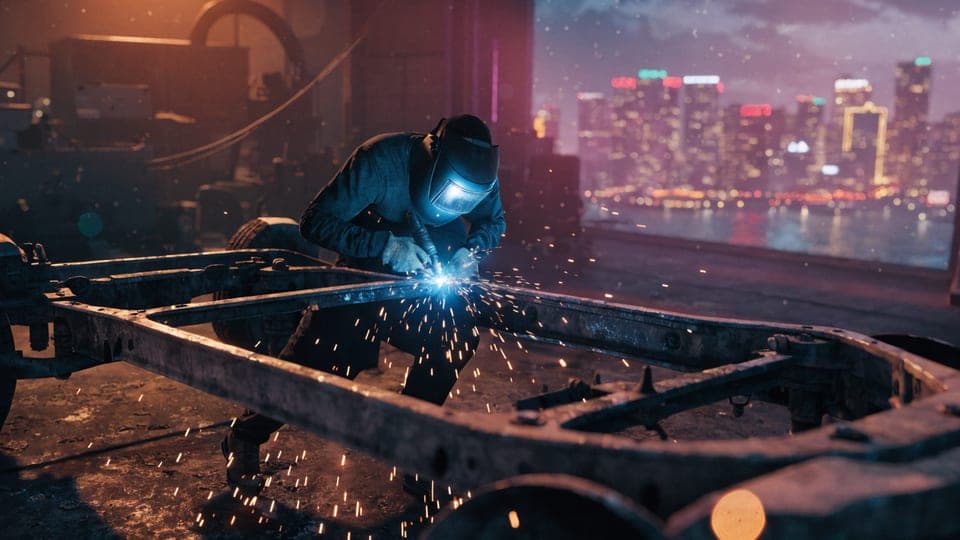
A skill-based welding minigame that runs a three-stage ox_lib skill check with a tightening timing window, gating frame and chassis repairs behind real player skill. Success restores body health; the value is committed on the server so the minigame can't be bypassed.
Prompt Template
You are writing a FiveM resource (resolve the framework via exports). Build a…
The full prompt template and its reference Lua are part of a one-time pack. Pick your depth, both are lifetime access, no subscription, ever.
- 60 prompts + syntax-validated reference Lua
- Lifetime access, pay once
- All 510 prompts, the full library
- Per-prompt profit/trend intelligence (CSV + playbook)
- Lifetime free updates, new niches as the market moves
$49 for 60 · $199 for all 510 + intelligence, one-time, no subscription.
Expected Output
The reference Lua at content/expected-outputs/mechanic/16-welding-repair-minigame.lua implements a three-stage oxlib skill check, an anim-gated weld, and a server that decides the restored body…
The full prompt template and its reference Lua are part of a one-time pack. Pick your depth, both are lifetime access, no subscription, ever.
- 60 prompts + syntax-validated reference Lua
- Lifetime access, pay once
- All 510 prompts, the full library
- Per-prompt profit/trend intelligence (CSV + playbook)
- Lifetime free updates, new niches as the market moves
$49 for 60 · $199 for all 510 + intelligence, one-time, no subscription.
Known Failure Modes & Corrective Prompt
- Client-trusted health, the client sets full body health and the server accepts it, so the minigame is skippable. Have the server derive the value from the success boolean alone.
- No weld anim,
TaskPlayAnimfires beforemini@repairloads, so the minigame runs over a static ped. - One-sided result event, the result event is registered on a single side and the round-trip drops.
Corrective re-prompt: Send only the success boolean and net id to the server, let the server return 1000.0 on success / no change on failure, register the result event on both sides, and load the weld dict with the while not HasAnimDictLoaded(dict) do Wait(0) end loop before TaskPlayAnim.
Framework Integration
- ESX: resolve with
exports["es_extended"]:getSharedObject(); require a "welding_torch" item viaxPlayerchecks before the skill check starts. - QBCore: resolve with
exports["qb-core"]:GetCoreObject(); gate onjob.name == "mechanic"and consume a "weld_rod" item per repair. - QBox: use
exports.qbx_corewithexports.ox_inventoryfor the torch/rod items andox_lib(already the minigame dependency) for the skill check.
Profit Potential
$80-$1200/mo on Tebex (expected ~$300), priced inside the $50-389 script band against a corpus of comparable Tebex sellers (median ~$11.85K/mo); a saturated category caps it low-band unless the skill curve differentiates it.
Trend Signal
↘ saturated, corpus: Repair minigames are dense on Tebex (scraper category density); edge = a real skill curve on ox_lib.
Sales Angle
Stand out in a crowded category with a genuine three-stage skill curve rather than a one-tap repair, sell the difficulty as the feature. Recommended Tebex price $50.
Difficulty & Ship Time
beginner · ships in 2-4h.